You must show your work to receive full credit. This assignment is due Monday, 5 February.
Add the following six-bit twos-complement number. Which, if any, of the additions result in an overflow?
Compute the following bit-wise logical operations on six-bit binary numbers.
Translate the first four characters of your last name into an ASCII hexadecimal string.
The following 32-bit strings represent IEEE floating point numbers. Translate the bits into their "normal" floating point representation. This is not an easy problem.
Draw a circuit that implements the truth table shown below. The "inputs" to the truth table are A, B, and C. The output is Z. Review section 3.3.4 before attempting this problem.
| input | output | ||
|---|---|---|---|
| A | B | C | Z |
| 0 | 0 | 0 | 0 |
| 0 | 0 | 1 | 0 |
| 0 | 1 | 0 | 1 |
| 0 | 1 | 1 | 1 |
| 1 | 0 | 0 | 0 |
| 1 | 0 | 1 | 0 |
| 1 | 1 | 0 | 1 |
| 1 | 1 | 1 | 0 |
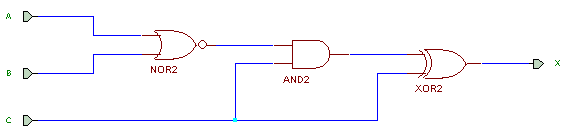
Complete a truth table to describe the logic circuit shown below.